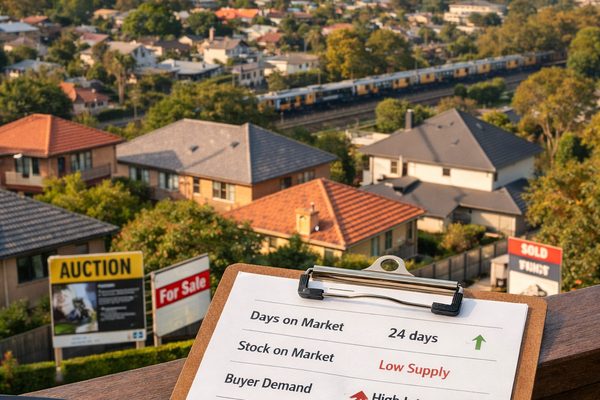
If you only read the headline, 2026 looks confusing. Some analysts now expect Sydney and Melbourne house prices to fall. Others still see solid gains in Perth, Darwin and parts of regional Australia. The Reserve Bank has lifted the cash rate again, inflation is still running above target, and housing supply is not keeping up cleanly with demand.
So what does that mean in plain English?
It means this is no longer a market where broad national calls are enough. The signal vs noise split matters more now. “Australian property” is not one market. It is a group of very different markets reacting to rates, affordability, migration, rents and local supply constraints at different speeds. That is the real takeaway from the transcript you shared. The big idea is directionally right: 2026 looks more divided, more local, and less forgiving of lazy suburb selection. But some of the stronger claims need pressure-testing before you act on them.
What’s happening right now
The clearest macro signal is monetary policy. The RBA lifted the cash rate target to 4.10% in March 2026, after another increase in February, which means borrowing conditions are tighter than many buyers expected only a few months ago. Inflation is still sticky too, with headline CPI at 3.8% in the year to January 2026, and housing one of the biggest contributors.
At the same time, supply is still not giving the market much relief. ABS data shows total dwelling approvals fell 7.2% in January 2026 to 14,564, driven by a sharp drop in approvals for private dwellings excluding houses. That matters because approvals are an early read on future stock. Fewer approvals now can mean tighter supply later.
The rental market is also still tight. SQM Research says the national residential vacancy rate fell to 1.1% in February 2026, with asking rents up 6.6% over the past 12 months. Tight vacancy does not automatically create capital growth, but it does keep pressure on rents, tenant demand and investor cashflow assumptions. Migration is lower than the peak, but still high enough to matter. ABS says net overseas migration was 306,000 in 2024–25, and 311,000 over the year to September 2025. That is below the extreme post-COVID rebound, but still well above pre-pandemic norms. In other words, demand pressure has eased, not disappeared.
Why the 2026 property forecast has changed
We've revised its 2026 base-case forecasts in March. Its updated view now has weighted capital city growth at 0% to 3%, down sharply from its earlier call of 6% to 10%. In the revised base case, Sydney is forecast at -6% to -2% and Melbourne at -4% to -1%, while Perth remains much stronger at 10% to 13% and Darwin at 12% to 16%.
That shift is a good example of second-order effects. Higher rates do not hit every market equally. Expensive, low-yield, highly leveraged cities usually feel it first because serviceability gets squeezed faster. More affordable markets with tighter supply and stronger rental pressure often hold up better. That does not mean every suburb in Perth is a win, or every suburb in Sydney is a risk. It means the broad state or capital-city call is only your starting point.
Sydney and Melbourne: weaker headline, mixed local picture
The transcript’s strongest point is also the one investors should remember: there are always markets within markets. Sydney and Melbourne are the most exposed to rate pressure because entry prices are high and mortgage sensitivity is real. If debt costs stay elevated, buyers at the margin have less room to move, and that usually weighs most on expensive stock first. SQM’s revised forecasts reflect exactly that. But here’s the catch. A weaker city-wide forecast does not mean every pocket is weak. Affordable family suburbs, areas with improving infrastructure, and locations with better yield support can still outperform a soft city backdrop. That is why broad media headlines often mislead. A city can be flat while selected corridors still attract demand because they sit at a better entry price, solve a lifestyle problem, or offer stronger holding power.
Rule of thumb: when rates are high, entry price vs holding power matters more than aspirational postcode prestige.
The regional Australia case is stronger than many people think
This part of the transcript is worth taking seriously, but with one caveat.
The case for regional Australia is not “regionals always beat capitals”. That is too simple. The better argument is that some regional markets still sit in a useful overlap of affordability, yield support and supply constraints. In a market where borrowing power is under pressure, that overlap matters.
Now, the part most people miss: tight supply can matter more in regional areas because new stock is often slower to deliver, trades are harder to source, and project viability is weaker. When approvals are falling nationally and migration is still elevated, some regional markets can stay tighter for longer than the consensus expects.
That said, “regional” is not a strategy on its own. Some markets are diverse and resilient. Others are thin, cyclical and too dependent on one employer or one industry. Yield can look attractive right before demand softens. This is why suburb-level due diligence matters more than the regional-versus-capital debate.
Signal vs noise: what actually matters for investors now
A lot of commentary in this cycle is noise. Here’s what matters.
First, rates and serviceability. A market can have strong long-term fundamentals and still stall if buyers cannot borrow enough. That is why higher-end Sydney and Melbourne stock is under more pressure right now.
Second, supply pipeline. Falling dwelling approvals are a live signal, especially when vacancy is already tight. If new stock does not arrive fast enough, rents stay firm and competition for established homes can stay stronger than expected.
Third, entry price and yield. In a tighter lending environment, high-yield or at least yield-supported assets have a bigger cashflow buffer. That does not remove risk, but it gives you more holding power.
Fourth, migration and household formation. Migration is off the highs, but still meaningful. Demand has cooled from extreme levels, not normalised back to a low-pressure market.
Risk check: what could break the bullish case outside Sydney and Melbourne?
This is where you need to stay disciplined. The upside case for affordable, supply-constrained markets is clear. But probabilities are not certainties. If inflation stays hotter for longer and the RBA keeps policy tighter, borrowing power could weaken further. That would eventually hit more than just Sydney and Melbourne.
If migration slows faster than expected, rental pressure could ease more quickly in some markets. If supply responds better than expected in specific corridors, price pressure can fade even while the national story stays tight. That is especially relevant in estate-heavy outer suburbs where new stock can distort medians and soften scarcity value.
And if you buy purely for yield in a thin local economy, you can still get caught by vacancy risk, weak resale demand or poor long-term owner-occupier appeal.
That is the trade-off. Cheap does not equal good. Expensive does not automatically mean safe. The goal is to buy where economics, demand and holding power line up.
What to do next if you’re buying or investing in 2026
If you’re thinking, okay, but what should I do, start here. Ignore the one-line market calls. They are useful for context, but weak for decision-making.
Build your shortlist around four filters:
-
Can you hold it comfortably if rates stay higher for longer?
-
Is supply constrained in a real way, not just in a headline?
-
Does the suburb have demand depth beyond one buyer type?
-
Are you buying into a cycle with support, or chasing a story that already ran?
That is the decision checklist that matters in this market. A common mistake is treating “best suburb” content as if it removes risk. It does not. The better move is to pressure-test your borrowing power, cashflow buffer, and suburb selection together.
AbodeFinder’s view
Our base case is simple. 2026 looks like a split market, not a clean national boom or bust. Sydney and Melbourne face more pressure because rates bite harder where prices are already stretched. More affordable markets with tighter supply and better rental support may still outperform, especially where the local economy and demand base are broad enough to absorb shocks. That view is consistent with current RBA, ABS and SQM data.
The practical next step is not to chase a forecast. It is to test whether the suburb and the numbers still work if the downside case shows up.
Run your numbers with the AbodeFinder Buying Chance Calculator. If suburb selection is the real risk in your plan, get an AbodeFinder Suburb Report and pressure-test the market, the cashflow and the trade-offs before you commit.