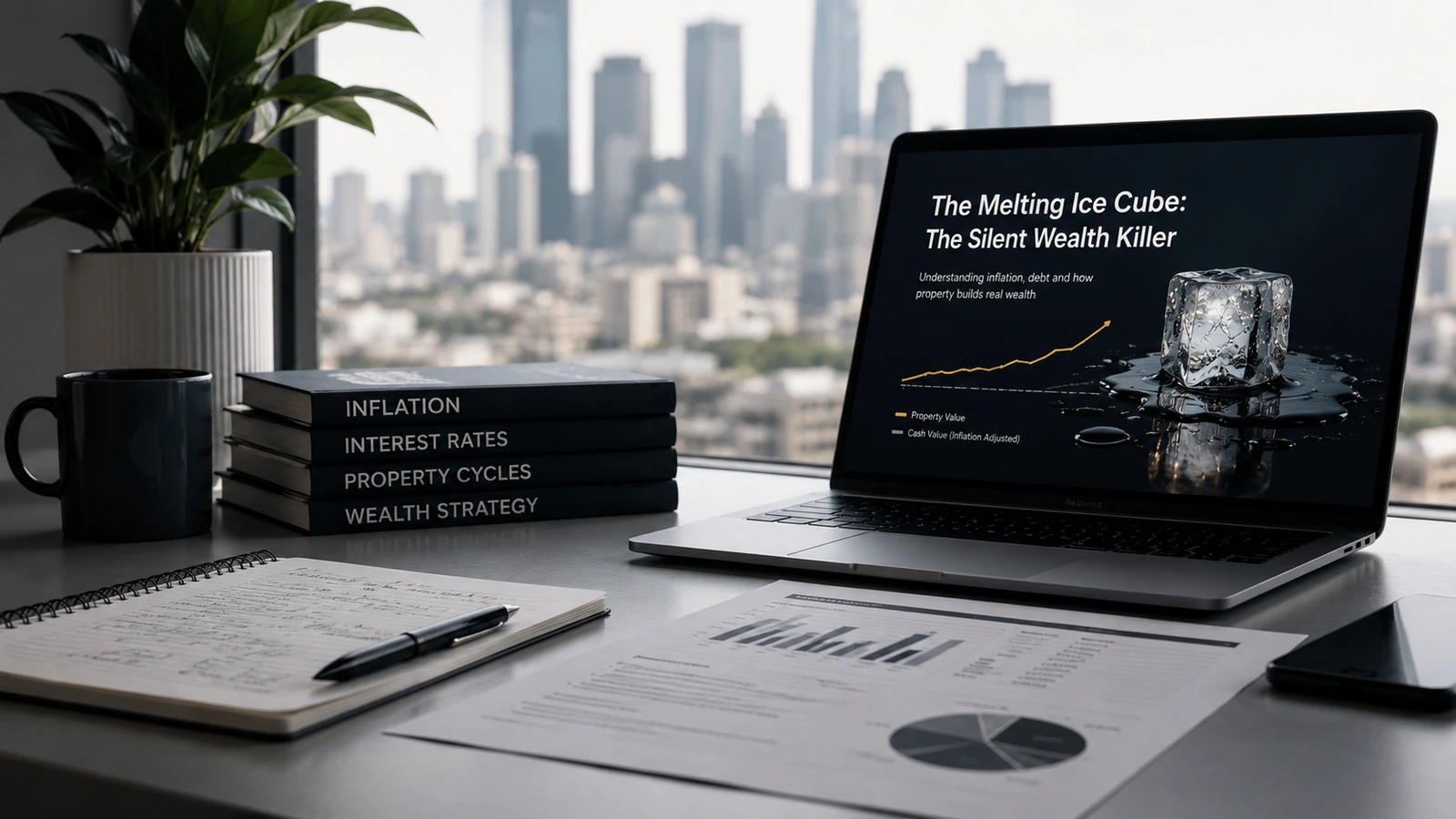
Leave an ice cube on the kitchen bench and the result is predictable.
It melts.
Cash can feel similar. The number in your bank account may stay the same, but what that money buys can shrink as prices rise.
That is the simple idea behind the “melting ice cube” theory. Inflation reduces the purchasing power of money over time, so people look for assets that may hold or increase their real value.
Property is often placed at the centre of that argument.
The logic sounds compelling. Use a deposit, borrow the rest, buy a scarce asset, collect rent and let inflation reduce the real burden of the debt.
But here is the catch.
Inflation does not turn every property into a good investment. It does not remove repayment risk. It does not guarantee wage growth. It does not protect you from overpaying, buying in an oversupplied market or holding an asset with weak rental demand.
The useful question is not whether cash melts.
It does.
The useful question is whether the asset you buy with it can outperform its financing costs, ownership costs and risks over the period you need to hold it.
That is where strategy starts.
General information only, not financial advice.
What does inflation do to your money?
Inflation is the rate at which the general level of prices rises over time.
The Reserve Bank of Australia aims to keep annual consumer price inflation between 2 and 3 per cent over time. In practice, inflation can sit above or below that range for extended periods.
When prices rise faster than the return on your savings, your purchasing power falls.
Imagine you have $100,000 sitting in cash.
At 3 per cent annual inflation, that money would still show as $100,000 in your account after 10 years. But it would buy roughly what $74,000 buys today.
At 4 per cent inflation, its purchasing power would fall to about $68,000 in today’s dollars.
The balance did not disappear. Its real value changed.
That is the signal.
The noise is the claim that cash is therefore useless.
Cash has several jobs. It gives you liquidity, protects you from forced selling and helps you survive vacancies, repairs, job loss and rate rises. A deposit sitting in cash while you prepare to buy is not necessarily wasted money. An emergency fund is not a failed investment.
The risk comes when large amounts of cash remain idle for years without a clear reason, while inflation runs above the return being earned.
Why inflation can make property look attractive
Property has characteristics that can help it respond to inflation over long periods.
Land is limited in established locations. Replacement costs can rise. Rents may increase as wages, household formation and housing demand change. A fixed loan balance may become smaller relative to future incomes and asset values.
That is the theory.
Suppose an investor buys a $700,000 property using a $140,000 deposit and a $560,000 loan.
Ten years later, the loan balance may still be substantial. But if wages, rents and the property’s value have increased, that original debt may be smaller relative to the investor’s income and the asset.
This is what people mean when they say inflation “erodes” debt.
The dollar amount does not magically fall. The real burden may fall if income and asset values rise while the nominal debt remains fixed or declines through repayments.
Now, the part most people miss.
The interest rate on that debt also matters.
If inflation pushes interest rates higher, repayments can rise quickly. An investor may own an asset that benefits from long-term inflation but still struggle with short-term cashflow.
That gap between long-term theory and short-term holding power is where portfolios break.
For a broader view of how rates, rents and serviceability interact, read The 2026 Property Playbook Most Investors Will Miss While Watching Interest Rates.
Debt is a tool, not a wealth strategy by itself
Property investors often describe mortgage debt as “good debt”.
That phrase needs context.
Debt is useful when it helps you acquire a productive or appreciating asset without creating an unacceptable chance of financial stress.
It becomes dangerous when the asset is weak, the price is too high or the borrower has no buffer.
Consider two investors.
The first buys a well-located house in a supply-constrained market with broad employment, stable tenant demand and manageable holding costs. They retain six months of cash reserves and can absorb higher repayments.
The second buys a new apartment at a premium in an area with a large supply pipeline. The yield looks reasonable, but strata costs are high, comparable properties are easy to build and the investor uses nearly every dollar of available savings.
Both investors used leverage.
Only one may have used it well.
Debt magnifies outcomes. It can increase gains when the asset performs, but it can also magnify losses and reduce flexibility when the assumptions fail.
Rule of thumb
Do not ask, “How much will the bank lend me?”
Ask, “How much debt can I carry without losing control of my options?”
Your maximum borrowing capacity and your sensible borrowing level are not the same number.
Before committing, use the AbodeFinder Buying Chance Calculator to get an initial view of how your budget aligns with the markets you are considering. Then pressure-test repayments at a higher interest rate.
Does Australian property always beat inflation?
No.
Property is not one market. Performance varies by city, suburb, property type, entry price and holding period.
Some assets grow faster than inflation. Some move sideways for years. Some fall in value. Some generate enough rent to support the loan. Others consume cash and restrict the investor’s next move.
Even when a national median rises, individual owners can underperform because they bought the wrong asset or paid too much.
A property can struggle when:
- local employment weakens
- new supply exceeds buyer or tenant demand
- insurance costs rise sharply
- zoning allows competing stock to be built easily
- the property has structural or strata issues
- rental yield is too low relative to debt costs
- the investor is forced to sell during a weak market
This is why “property beats inflation” is not a complete investment thesis.
The property needs a reason to remain wanted.
That reason may be land scarcity, access to employment, school zones, infrastructure, lifestyle, affordability or a combination of demand drivers. It should not rely on a slogan about prices doubling every decade.
AbodeFinder has examined that assumption in Do Australian House Prices Really Double Every 10 Years?. The better approach is to assess probabilities, not repeat a national rule that may not apply to your asset.
The cash problem is real, but so is the holding-cost problem
The “melting ice cube” metaphor focuses attention on purchasing power.
Useful.
But investors also need to watch the bucket underneath the ice cube.
That bucket is cashflow.
Your property may have a long-term growth case, but you still need to pay the mortgage, council rates, insurance, maintenance, property management, land tax where applicable and vacancy costs.
Suppose an investment property costs you $500 a month after rent and expenses.
That may be manageable.
Now assume the interest rate rises, insurance jumps, the hot-water system fails and the property sits vacant for four weeks.
The real holding cost may be much higher than the spreadsheet first suggested.
That does not automatically make it a bad investment. It means the strategy needs enough room for reality.
Risk check
Before buying, model three cases.
Base case: current rent, current rate and normal expenses.
Downside case: rates rise by 1 percentage point, the property is vacant for four weeks and annual maintenance is higher than expected.
Stress case: temporary income loss occurs at the same time as a major repair or refinance.
If the deal only works in the base case, it does not have a buffer. It has a hope.
Inflation can reduce debt’s real value only if income keeps up
One of the more attractive parts of the inflation argument is that future wages may make an old mortgage feel smaller.
Sometimes that happens.
But it is not automatic.
If household expenses rise faster than wages, the borrower can feel poorer even while their salary increases. If interest rates also rise, a larger share of income may go towards repayments.
This is why nominal income and real income are different.
Nominal income is the number on your payslip.
Real income is what that income can buy after inflation.
An investor earning more money in five years may still have less spare cash if housing, food, transport, insurance and other costs have risen faster.
So what does that mean in plain English?
You cannot rely on inflation to rescue an overstretched loan.
The purchase should be survivable based on realistic income growth, not the assumption that future-you will earn enough to solve today’s problem.
Supply is where the inflation story meets property
Inflation affects more than household spending.
It can raise construction costs through labour, materials, finance, energy and compliance expenses. If projects no longer stack up for developers, some are delayed or cancelled.
That can restrict future housing supply.
When demand continues but new construction slows, established housing may become more valuable because replacement is expensive and new stock is limited.
But this effect is not uniform.
A suburb can still face oversupply even when the country has a broad housing shortage. Large apartment precincts, investor-heavy developments and areas with abundant developable land can behave differently from tightly held established neighbourhoods.
This is why national housing-shortage headlines are not enough.
You need to inspect the local supply pipeline.
Look at dwelling approvals, projects under construction, zoning, vacant land, developer activity and the type of stock being delivered. Ten thousand dwellings nationally tells you little about the two-bedroom apartment you are considering.
When comparing locations, use an AbodeFinder Deal Review to assess the property, suburb, likely price range, key risks and whether the deal deserves further investigation.
Signal vs noise: what matters most?
The noise is dramatic.
“Cash is trash.”
“Debt makes you rich.”
“Property always goes up.”
“You will own nothing.”
None of those statements is useful enough to guide a six or seven-figure decision.
Here is the signal.
Inflation creates a cost for holding cash over long periods.
Productive and scarce assets can protect purchasing power, but only when bought at a sensible price and held through the cycle.
Debt can help you control a larger asset base, but it also increases repayment risk.
Property can perform well during inflationary periods, but rates, serviceability and household costs can create short-term pressure.
Supply constraints matter, but they must be tested at suburb and property level.
Holding power matters more than predicting the next headline.
A practical example
Consider a professional couple with a combined income of $230,000 and a $180,000 deposit.
They are worried that property prices will move beyond their reach, so they consider buying an $850,000 investment property.
On paper, they can afford it.
But their plan changes when they pressure-test the numbers.
One partner works in a cyclical industry. They are planning to have a child within two years. The property has a low rental yield. The loan would use most of their serviceability, and the purchase would leave only $12,000 in cash.
The suburb may have a reasonable growth case.
The deal may still be wrong for them.
A lower entry price, stronger yield or delayed purchase may preserve more flexibility. Alternatively, they may decide to buy after building a larger buffer.
That is not fear.
It is matching the asset to the household.
Property strategy is personal because risk capacity is personal.
The investor decision checklist
Before using inflation as a reason to buy, answer these questions clearly.
What is the purpose of the asset?
Is it intended to deliver capital growth, stronger yield, portfolio diversification or future owner-occupation?
Can you hold it?
What happens to your monthly cashflow if the interest rate rises by 1 percentage point?
Is the property scarce?
Can developers create hundreds of close substitutes nearby?
What supports demand?
Are employment, population, wages, infrastructure and affordability working in the same direction?
What could break the thesis?
Could insurance, vacancy, oversupply, building defects or local job losses change the result?
Does it preserve your next move?
Will the property strengthen or weaken future serviceability?
Are you buying the asset or reacting to fear?
A good asset bought under emotional pressure can still become a poor decision if you overpay.
What should buyers do with cash in an inflationary period?
There is no single answer.
Some cash should remain liquid. That includes your emergency fund, near-term expenses, tax obligations and the buffer needed to hold an investment.
Money with a long time horizon may need a different job.
That could include property, shares, superannuation or other investments that suit your goals and risk tolerance.
The trade-off is simple.
Cash offers stability and access, but may lose purchasing power.
Growth assets can offer stronger long-term returns, but their values move and they can create losses.
Debt can accelerate asset ownership, but reduces flexibility.
The right mix depends on your income stability, timeframe, household plans and ability to hold through a downturn.
The bottom line
The melting ice cube theory contains a useful warning.
Doing nothing with long-term savings has a cost when inflation is running above the return on cash.
But the theory becomes dangerous when it is used to justify any property, any debt or any price.
Inflation may support asset values over time. It may also bring higher interest rates, tighter serviceability and more expensive household budgets.
The goal is not to escape cash as quickly as possible.
The goal is to convert part of your capital into the right asset, with the right debt level, while keeping enough liquidity to stay in control.
That is how investors position for the cycle without betting their household on a headline.
Practical next step: Explore AbodeFinder’s property advisory services and get a clearer view of your suburb options, property risks, price range and buying strategy before you commit.
General information only, not financial advice.