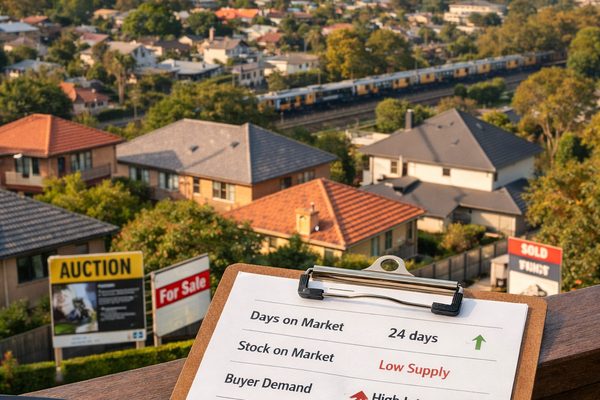
Most property commentary is too broad to be useful. “Sydney is rising.” “The market is turning.” “Affordable suburbs will outperform.”
That kind of advice sounds sharp, but it does not help much when you are trying to choose one suburb, one property, at one entry price, with your own borrowing limits and risk profile. That is the problem.
You do not buy a capital city. You buy a specific asset in a specific suburb. So if you want to make better property decisions, you need to get closer to the real signal. That signal sits at suburb level. Here’s what matters: strong suburbs usually show signs of tightening before the wider market fully notices. Demand starts building. Listings get absorbed faster. Discounting falls. Supply looks thinner. Then prices move. The buyers who do best are not usually the loudest. They are the ones reading those signals earlier and pressure-testing the risks before the headline writers catch up.
Property growth is built at suburb level, not city level
A city-level call is not enough. Even in a rising market, some suburbs move first, some move harder, and some barely move at all. That is why broad market commentary often creates more noise than clarity.
A suburb can outperform because:
-
buyer demand is rising faster than local supply
-
stock on market is low
-
days on market are falling
-
vendor discounting is tightening
-
nearby suburbs are also strengthening, which creates price pressure across a cluster
That is a more useful lens than generic talk about “good infrastructure” or “nice lifestyle”. Those things can support long-term appeal. They do not always explain why prices move sharply over the next one to three years.
What actually drives a suburb into a stronger growth phase
Most buyers overfocus on story and underfocus on behaviour. They want a suburb that sounds good. A suburb with cafés, a train line, a clean reputation, or a story they can repeat to themselves. But growth is usually driven by something simpler: more buyers competing for limited stock.
So what does that mean in plain English? It means the market starts tightening before it looks obvious on the surface.
You might see:
-
listings selling faster
-
fewer price cuts
-
stronger online search activity
-
more competition in a cluster of nearby suburbs
-
limited new supply in the short term
That combination matters far more than suburb image on its own. This is the signal vs noise split.
The data points that matter more than the headlines
If you are trying to identify a suburb with a better growth setup, start with the market mechanics.
Days on market
This tells you how long properties are taking to sell. If days on market are falling, demand is usually getting stronger. Buyers are moving faster. Sellers have more leverage. That is often an early sign of tightening conditions.
Stock on market
This shows how much supply buyers can choose from. Low stock matters because scarcity creates pressure. If buyers have fewer options and demand stays steady or rises, prices usually respond.
Vendor discounting
This is the gap between the asking price and the sold price. If discounting is shrinking, the market is firming. Sellers do not need to negotiate as much. Buyers have less room to bargain.
Search interest
This is not a perfect metric on its own, but it helps. If online attention is rising while stock remains tight, it usually points to stronger buyer intent building underneath the market.
Supply pipeline
This is one of the most missed pieces. A suburb can look strong on paper, but if there is a large land release, rezoning push, or townhouse pipeline coming through, scarcity can disappear fast. That can cap growth or stretch out the cycle. This is why due diligence matters. You are not just asking whether a suburb is improving. You are asking whether future supply could break the thesis.
Signal vs noise: what most buyers get wrong
A lot of property buyers still anchor to the wrong things. They overrate:
-
media sentiment
-
auction clearance chatter in isolation
-
suburb reputation
-
old assumptions about “good” and “bad” areas
-
broad city forecasts with no suburb detail
They underrate:
-
local demand depth
-
listing scarcity
-
local supply risk
-
serviceability pressure
-
holding power
-
cluster strength across nearby suburbs
Now, the part most people miss: a suburb does not need to look prestigious to perform well. Markets do not reward status. They respond to pressure.
If a suburb is affordable relative to nearby alternatives, demand is lifting, and supply is constrained, it can outperform while more “desirable” suburbs move slower.That does not mean every cheaper suburb is a buy. It means affordability only matters when it sits inside a stronger demand-supply setup.
Why suburb clusters matter
One strong suburb is interesting. A cluster of strengthening suburbs is more useful. If one suburb in a corridor is rising, buyers can still spill into cheaper nearby options. But if several nearby suburbs are tightening together, that creates more sustained price pressure. Why? Because substitution gets harder. Buyers who are priced out of one suburb cannot simply move next door and save money if the whole local pocket is moving. That is when pricing pressure spreads across an area. This is one of the clearer signs that a local cycle is building strength.
Risk check: what could break the growth story
No suburb should be treated like a sure thing.mBetter buyers run a risk check before they get emotionally attached to the upside case. Here are the main questions to pressure-test.
Could future supply flood the area?
Large estates, rezonings, and dense development approvals can weaken scarcity fast. That matters in outer growth corridors especially.
Is the property type easy to replicate?
A scarce house on decent land and a unit in a heavy-supply pocket do not carry the same upside or risk profile.
Can you hold it comfortably?
Entry price matters, but holding power matters more. A suburb can still be a poor fit if the cashflow strain is too high for your buffer.
Are you buying the suburb, or the specific asset?
A good suburb does not automatically make every property inside it a good buy. Asset selection still matters.
Are you using current data, or an old story?
This is a common trap. Buyers hear that a suburb “did well last boom” and assume it still has the same setup now. Sometimes it does. Sometimes the supply picture has changed completely.
A practical rule of thumb
If you want a simple way to filter stronger suburb candidates, start here: Look for rising demand, low stock, falling days on market, tighter discounting, and manageable future supply risk. Not one factor. The combination. That does not give certainty. It gives a stronger probability. And that is the right goal in property. Probabilities, not certainties.
What to do next if you are trying to buy well
If you are thinking, “Okay, but what should I do?”, start with a shortlist, not a suburb crush.Pick a few suburbs that fit your budget and strategy. Then pressure-test each one through the same lens:
-
demand strength
-
supply pipeline
-
entry price
-
holding costs
-
yield
-
vacancy risk
-
zoning and development risk
Then check whether the actual property fits the suburb thesis.This is where many buyers slip. They find a suburb with a decent base case, then buy weak stock inside it. The suburb does not save a bad asset.
Final word
The market usually moves before the headlines become comfortable. That is why buyers who rely on general commentary tend to arrive late. By the time the story feels safe, a lot of the repricing has already happened. The better approach is calmer and less exciting. Read the suburb-level signals. Ignore the noise. Run a risk check. Then make a decision based on probabilities, not hype.
Practical next step: Get an AbodeFinder Suburb Report if you want a suburb assessed through a data, risk and strategy lens before you commit.