The cost of living in Australia in 2026 has created a strange contradiction.
Your salary may be higher than it was a few years ago. Your super balance may be larger. The value of your home may have increased. The Australian economy is still technically growing.
Yet you may feel as though you are moving backwards.
Groceries cost more. Housing costs more. Insurance costs more. Mortgage repayments absorb a larger share of household income. Even households earning strong professional salaries are questioning why there seems to be less left at the end of each month.
That feeling is not necessarily poor budgeting.
It is the difference between nominal wealth and real purchasing power.
Nominal wealth is the number you see in your bank account, salary or property valuation.
Real purchasing power is what that number can actually buy.
In 2026, that distinction matters.
The Australian economy is growing, but the pressure is real
The latest Australian Bureau of Statistics national accounts showed GDP increasing by 0.3% during the March 2026 quarter and 2.5% over the year.
That sounds reasonably healthy until you look beneath the headline.
GDP per person fell by 0.1% in both the December 2025 and March 2026 quarters. Using the common definition of two consecutive quarterly declines, Australia had moved back into a per capita recession.
The economy became larger, but the amount of economic output per person became slightly smaller. (Australian Bureau of Statistics)
This is one reason the national numbers can feel disconnected from household experience.
Population growth can lift total GDP even when the average person is not becoming more productive or financially comfortable. A growing economy does not automatically mean rising living standards.
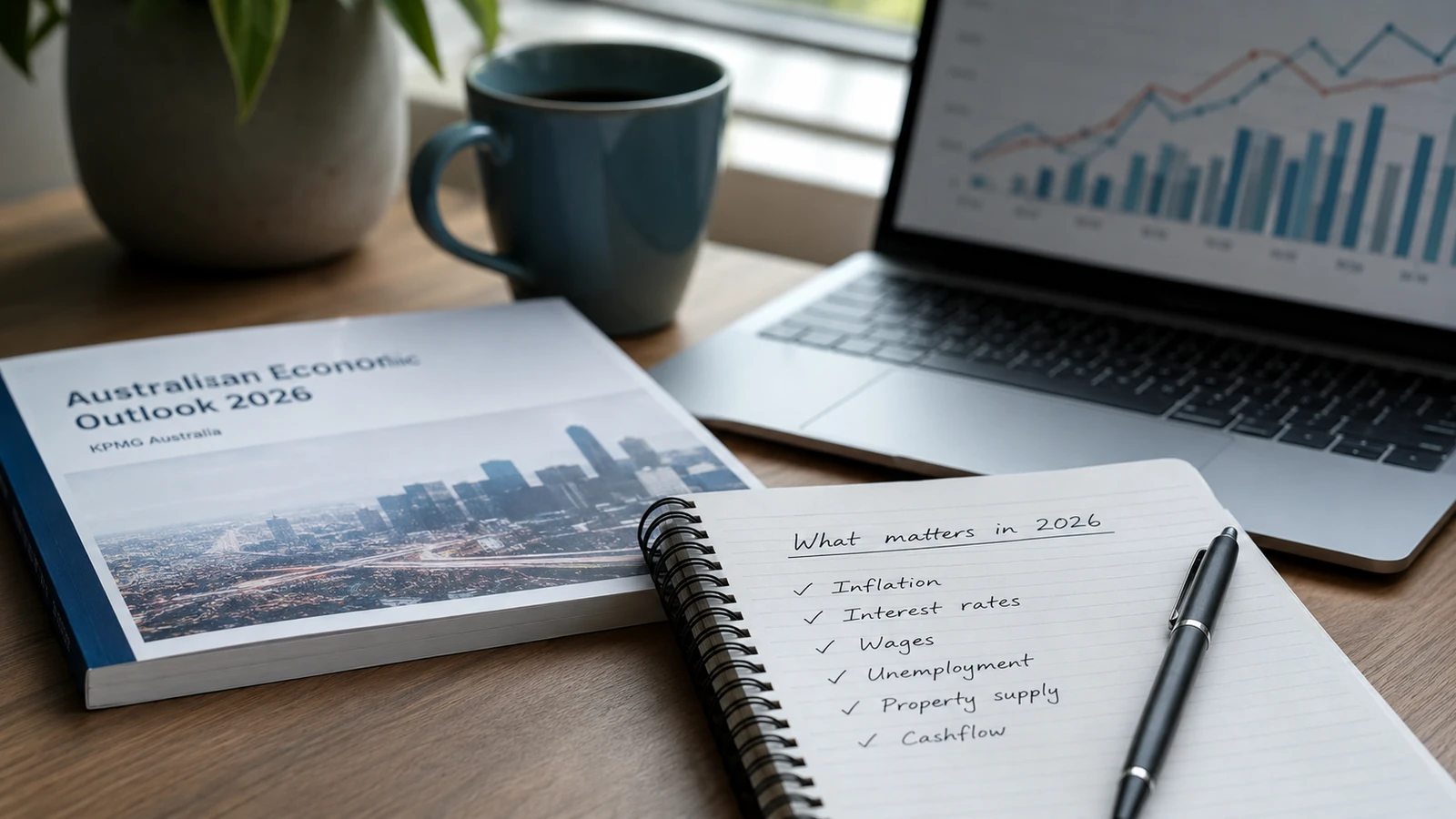
KPMG’s July 2026 Australian Economic Outlook points to further weakness ahead. It forecasts year-ended real GDP growth slowing from 2.5% in 2025 to 1.2% by the end of 2026, before recovering gradually to 1.6% in 2027 and 1.9% in 2028.
These are forecasts, not certainties. But the direction matters.
KPMG’s base case is a slower economy, persistent inflation, tighter financial conditions and a softer labour market. (KPMG)
So what does that mean in plain English?
Australia is not necessarily heading towards an immediate economic collapse. It is facing a period where household incomes, borrowing power and confidence could remain under pressure even if the country avoids a technical recession.
That is a difficult environment for people trying to save, invest or buy property.
Why higher wages are not making Australians feel wealthier
Australian wages rose 3.3% over the year to the March 2026 quarter, according to the ABS.
Annual consumer price inflation was 4.0% in May 2026. Housing costs increased by 6.5%, while food and non-alcoholic beverages increased by 3.3%.
The wage and inflation figures cover slightly different periods, so they should not be treated as a perfect comparison. They still point to the same household problem.
Many prices are rising as fast as, or faster than, wages. (Australian Bureau of Statistics)
The impact is also uneven.
A household spending a large share of its income on housing, transport, childcare, insurance and food may experience a personal inflation rate well above the national average.
This is the part most people miss.
The Consumer Price Index measures the average movement in a basket of goods and services. Your household does not buy the average basket.
A mortgage holder facing higher repayments has a different experience from a debt-free retiree.
A renter receiving an 8% rent increase has a different experience from a homeowner with a fixed housing cost.
A family with two cars and three children has a different cost base from a single professional living close to work.
Inflation is national. Financial pressure is personal.
Your cash is not disappearing, but its purchasing power is
Cash is not worthless.
It pays bills. It covers emergencies. It protects you from being forced to sell an investment during a weak market. It gives you flexibility when your income changes, a tenant leaves or a major repair arrives.
The problem begins when cash is treated as a long-term wealth strategy rather than a short-term financial tool.
If inflation is running at 4%, $100,000 sitting in an account with no return would still display a balance of $100,000 after one year.
It would simply buy roughly what $96,000 buys today.
The money did not disappear. Its purchasing power declined.
Even when a savings account earns interest, the real result depends on the interest rate, inflation and tax paid on the interest.
A high headline savings rate can still produce a weak real return.
AbodeFinder has examined this issue in more detail in Your Cash Is Melting. But Buying Property Is Not Automatically the Answer.
The core lesson is simple.
Holding too much cash for too long creates inflation risk.
Holding too little cash creates liquidity risk.
The answer is not to eliminate cash. It is to give every dollar a job.
Signal vs noise: cash is not the enemy
The noise says cash is useless and everyone must immediately move their money into hard assets.
That is too simple.
Here is the signal.
Cash is useful when it protects your household, supports an upcoming purchase or prevents forced selling.
Cash becomes less useful when large amounts remain idle for years without a defined purpose while inflation continues reducing their purchasing power.
A deposit being held for a property purchase is not necessarily wasted money.
An emergency fund is not a failed investment.
A cashflow buffer supporting a negatively geared property is doing a valuable job.
But surplus cash held indefinitely because every investment decision feels uncomfortable can create a different risk. The household may feel safe while gradually losing financial ground in real terms.
The relevant question is not, “Should I hold cash?”
It is, “How much cash does my plan actually require?”
Why property looks attractive during inflation
Property has several characteristics that can help it preserve purchasing power over long periods.
Land is limited in established locations. Construction costs tend to rise over time. Rents may increase when incomes and housing demand rise. Replacement properties become more expensive to build. A fixed amount of debt can also become smaller relative to future wages and rents.
That is the attractive part of the inflation argument.
But here is the catch.
Inflation can also cause the RBA to raise interest rates.
The RBA cash rate was 4.35% as at 17 June 2026 following three increases during the first half of the year. KPMG forecasts the cash rate reaching 4.60% by the end of 2026 before easing to 4.35% in 2027. (Reserve Bank of Australia)
The RBA’s May outlook was even more cautious on near-term inflation. Its baseline forecast expected headline inflation to peak at 4.8% during mid-2026, with underlying inflation remaining above 3% until mid-2027. (Reserve Bank of Australia)
Higher inflation can support the replacement value of property.
Higher rates can simultaneously damage serviceability and cashflow.
That is the trade-off.
Property is not an automatic inflation hedge. The asset still needs sufficient demand, a defensible entry price, manageable debt and enough rental income to survive the holding period.
Debt only helps when you can hold it
Inflation can reduce the real value of debt over time.
Imagine borrowing $600,000 today. If wages, rents and prices rise over the next 15 years, the original loan may become smaller relative to the income and asset value supporting it.
That sounds attractive.
But the effect takes time.
The bank still requires each repayment along the way.
If the interest rate rises before your income or rent increases, the loan becomes harder to hold. If your employment weakens at the same time, the property may become a financial constraint rather than an inflation hedge.
This is why entry price and holding power matter more than the slogan “property beats inflation”.
A strong asset bought with an unsustainable loan can still be a poor decision.
A more modest asset bought with a sensible cashflow buffer may produce the better result because the owner can hold it through the cycle.
Before committing, use the AbodeFinder Buying Chance Calculator to get an initial view of how the purchase could fit your current position.
Then pressure-test the repayments at a higher rate.
The property should not require falling interest rates to remain affordable.
The danger of waiting for complete certainty
Many potential buyers are waiting for three things.
They want inflation to fall, interest rates to come down and the economy to feel safer.
That position is understandable.
It can also create a timing problem.
When economic confidence improves, buyer confidence often improves with it. Lower rates can increase borrowing power. More buyers can return to inspections. Competition can rise before a cautious buyer feels fully comfortable.
Waiting for certainty can therefore mean buying into a more competitive market.
But buying early is not automatically better either.
A softer economy can reduce employment security. Banks can tighten lending. Some markets can fall. A buyer who moves too aggressively may discover that their buffer was designed for the good scenario rather than the difficult one.
The useful position sits between fear and overconfidence.
Prepare before conditions feel comfortable.
Understand your borrowing position. Build the buffer. Define the type of property you want. Research several markets. Decide what would cause you to walk away.
Then act when the numbers fit, rather than when the headlines become reassuring.
A recession would not affect every property market equally
There is frequent discussion about whether Australia will enter a technical recession.
The honest answer is that nobody knows with certainty.
KPMG expects weak growth, but its published base case still shows positive annual growth. The RBA also expects softer economic conditions and a gradual rise in unemployment rather than treating a deep recession as its central forecast. (KPMG)
A recession would normally weaken household confidence, employment and borrowing demand.
That can reduce transaction volumes and place pressure on property prices.
But property is not one national market.
An area with diverse employment, tight listings, limited new construction and strong rental demand may remain relatively resilient.
An investor-heavy apartment market with weak owner-occupier demand and a large supply pipeline may behave very differently.
This is why a national recession call cannot tell you whether a specific suburb or property is a good purchase.
AbodeFinder’s analysis of the housing supply signal investors are missing explains why dwelling completions, local vacancy and competing stock often matter more than national housing-shortage headlines.
The economic cycle provides context.
Local constraints determine how that cycle reaches the property.
What lower interest rates could really mean
Investors often treat lower rates as an automatic positive.
Lower mortgage rates can improve cashflow and borrowing power. They can also support property prices by allowing buyers to service larger loans.
But the reason rates are falling matters.
If the RBA cuts because inflation has returned to target while employment remains stable, that can create a supportive environment for housing.
If the RBA cuts because unemployment is rising quickly and the economy is contracting, households may become more cautious even as loans become cheaper.
Banks may also adjust their risk settings.
A lower cash rate does not guarantee that every borrower will qualify for a larger loan. Income security, lender buffers, existing debts and credit policy still matter.
This creates a second-order effect.
The first buyers able to access improving credit conditions may benefit before the broader public feels confident. By the time the economic story looks safe, prices in some markets may already reflect easier borrowing conditions.
This does not mean buying before a downturn.
It means preparing your finances before the opportunity becomes obvious.
Risk check: what could break the property strategy?
The first risk is persistent inflation.
If inflation remains above target, rates may stay higher for longer. A property with weak yield or a large cashflow shortfall could become harder to hold.
The second risk is labour-market weakness.
KPMG expects unemployment to move higher as economic growth slows. Even a small national increase can matter greatly to a household that loses one income.
The third risk is local oversupply.
Australia can have a national housing shortage while individual suburbs face too many similar apartments, expanding land supply or weak rental demand.
The fourth risk is overpaying.
A good suburb is not a good purchase at every price. A buyer who pays too much reduces yield, increases debt and relies more heavily on future growth.
The fifth risk is assuming rents will solve the cashflow.
Rent growth can help, but tenants also have affordability limits. Higher rents cannot increase indefinitely while wages remain under pressure.
These risks do not mean property should be avoided.
They mean the strategy needs to work without perfect conditions.
A practical property strategy for Australia’s 2026 economy
Protect the household before chasing the asset
The first job of cash is protection.
Keep enough liquidity for personal expenses, vacancies, repairs and unexpected income disruption. The correct buffer depends on job security, household expenses, property costs and the number of incomes supporting the loan.
A household with two stable professional incomes may require a different buffer from a self-employed buyer with variable revenue.
The buffer should be based on risk, not an arbitrary online rule.
Separate emergency cash from investment capital
Emergency cash should remain accessible.
Capital that will not be required for several years can be assessed differently.
This separation prevents every dollar from being treated as either fully invested or fully idle. It also helps buyers avoid investing money that may be required during a difficult period.
Pressure-test the debt
Model the property using current rates, not hoped-for future cuts.
Then test a downside case with higher repayments, several weeks of vacancy and larger maintenance costs.
The ABS reported that the household saving ratio fell from 7.0% to 6.2% in the March quarter because nominal household consumption grew faster than gross disposable income. That is a reminder that household buffers can shrink quickly when costs move faster than income. (Australian Bureau of Statistics)
A property that works only when everything goes right does not have a strategy. It has a narrow margin for error.
Buy local scarcity, not a national story
Do not buy simply because Australia needs more housing.
Check the supply pipeline for the specific property type.
Look at vacancy, rents, buyer depth, local wages, zoning, land availability and competing development.
An established house in a tightly held suburb has different supply constraints from an apartment in a precinct containing several approved towers.
The national shortage may support both markets in theory. The local data may support only one.
Buy for the next move
Your first purchase should not consume every dollar of savings and every dollar of borrowing capacity unless one property is the full strategy.
For portfolio builders, the first asset needs to leave enough flexibility for the second.
That may mean accepting a lower entry price, stronger rental yield or different market.
AbodeFinder’s 2026 Property Investment Playbook explains why serviceability, supply, yield and sequencing need to be assessed together rather than as separate decisions.
Rule of thumb: cash buys time, assets build wealth
A useful rule of thumb is this:
Cash should protect your ability to hold.
Assets should provide your opportunity to grow.
Too much debt with too little cash leaves you exposed to short-term shocks.
Too much cash with no long-term plan leaves you exposed to inflation.
The goal is not to choose between cash and property.
The goal is to hold enough cash to remain in control while owning assets with a credible reason to outperform inflation and their holding costs over time.
That balance will be different for every household.
The bottom line
Australians are not imagining the financial pressure.
The economy may be larger and salaries may be higher, but inflation, housing costs and interest rates determine how much those incomes can actually buy.
KPMG’s 2026 outlook does not say Australia is facing an unavoidable disaster.
It points to a slower, more difficult cycle where inflation remains elevated, growth weakens and households need to make decisions with less room for error.
For property investors, this is not a simple instruction to buy.
It is an instruction to prepare.
Keep a real cashflow buffer. Understand your borrowing constraints. Do not rely on rapid rate cuts. Check the local supply pipeline. Buy an asset that fits the household rather than forcing the household to fit the asset.
The investors who handle this period well may not be the ones making the boldest economic prediction.
They may simply be the ones who understand what their cash is for, what their property needs to do and what could break the plan.
Practical next step
If you know you want to buy but are unsure which markets and property types fit your budget, goals and risk level, get an AbodeFinder Suburb Shortlist & Buy Box.
We will narrow the search to three to five suitable suburbs, define what to target, identify what to avoid and give you a clearer framework before you start reacting to random listings.
General information only. Not financial advice. Economic data and forecasts are current as at 17 July 2026 and may change.